Agar Agar - Everything You Need to Know
It is a type of plant-based gelatin widely used in vegan pastry. Agar agar is a food additive belonging to the category of thickeners. It is identified with the code E406, and it is with this code that it is found on food product labels. Thickeners are hydrocolloids, meaning they absorb water and then form a gelatinous or viscous substance. So if added to a liquid they do not dissolve but bind the water until creating a gel.
How is it produced?
Agar agar was discovered in Japan; it is a 100% plant-based product as it is extracted from red algae.
What does it look like?
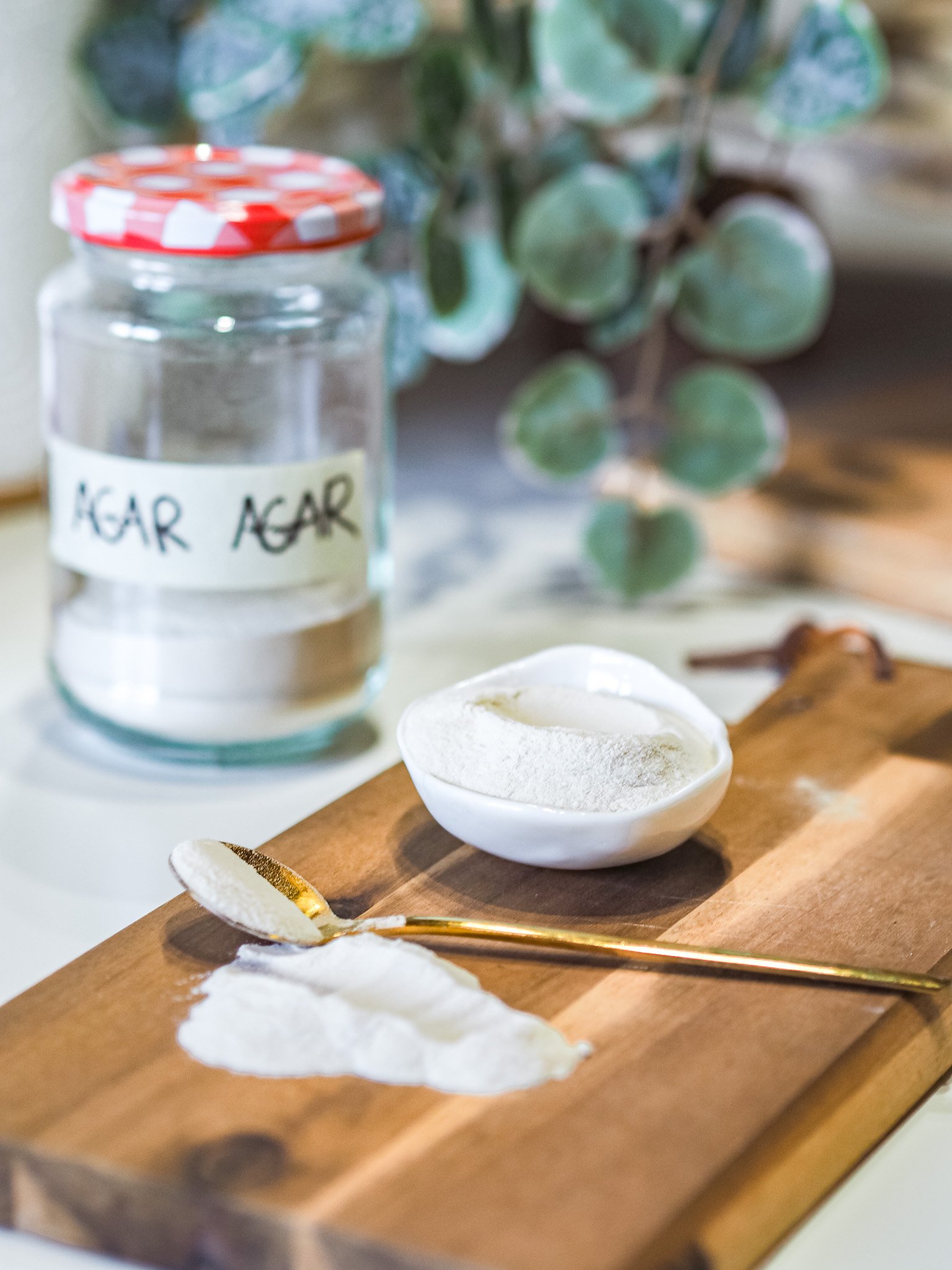
It appears as a fine, whitish powder.
What does it taste like?
Agar agar is odorless, colorless and tasteless, so it does not alter the flavor of the product being made. It is therefore suitable for both sweet and savory dishes.
How is it used?
It is soluble in liquids. It is soluble when hot, which means that when added to cold liquid it does not form any immediate gel. It is added to the liquid to be gelled, stirring with a whisk or preferably blending with an immersion blender. It is brought to a boil to activate it (it activates at about 80˚C; bringing to a boil ensures activation), it is not necessary to boil for long. During cooling, a gelled compound gradually forms; this happens at a temperature of about 30/40°C. For complete gelation it is necessary to rest for several hours in the fridge. Unlike sheet gelatin, therefore, it does not need soaking. It is not necessary to heat all the liquid you wish to gel; you can heat a portion of the liquid with the agar and then add the remaining cold liquid and then gel all together.
What properties does it have?
It forms a transparent gel, slightly elastic, hard and brittle; it is not pudding-like or creamy on the palate. It thickens at temperatures between 30 and 40 °C while it melts between 80 and 90°C. It is therefore thermoreversible, meaning that once it has gelled we can heat it and dissolve it again, and it will thicken again; we can do this indefinitely. This is a very interesting characteristic. On the downside, it is difficult to dissolve in the mouth so it may not be very pleasant. One last but very important property: it is not resistant to freezing. Agar is therefore not suitable for preparations that need to be frozen because during thawing it could release water: syneresis. It has an extraordinary hygroscopic capacity; in fact it swells by absorbing up to twenty times its weight in water when brought to the boil.
How much is used?
Agar gels at very low concentrations, starting from 0.2% up to 2% relative to the liquid to be gelled.
Where to buy?
It is very easy to find online such as on Amazon or kitchen/pastry shops like Sapore Puro, but today it is also easily available in common supermarkets.
How much does it cost?
Per 100 g the price ranges from about 7 to 12 euros.
Storage
Store in a dry, cool place and not in direct sunlight. Use by the expiration date on the package.
Here are some recipes where you can find it: